Paw Dragging in Dogs: Why Every Breed Needs Its Own Kind of Protection


Paw Dragging in Dogs: Why Every Breed Needs Its Own Kind of Protection
Guest post by Janne Loiske, founder of BARK & SOLE
If your dog has started scuffing their toes on every walk, you have probably heard it before you saw it: a soft scrape on the sidewalk, step after step. For many dog owners that sound is the first sign of paw dragging. It is one of the most common side effects of intervertebral disc disease (IVDD) and degenerative myelopathy (DM). And as November turns the sidewalks cold, wet and salted, it gets harder to ignore.
My name is Janne Loiske. I am the founder of BARK & SOLE, where we make dog shoes to each dog's own paw measurements. So far we have measured paws of more than 40 breeds. The biggest lesson from all those measurements is simple: a dog's breed shapes its paws far more than most people realize, and that changes how you protect them.
In this article, I will explain what paw dragging looks like, what our measurement data shows about breed differences, and why front and back paws need different solutions. I will also share what we learned from three of Alpha Animal Rehab & Fitness's own patients: Stella, a German Shepherd, and Cacha and Webber, two French Bulldogs.
Recognizing Paw Dragging and Knuckling in Dogs
Paw dragging happens when the signals between the spinal cord and the legs weaken. The dog no longer lifts the paw cleanly, so the toes brush along the ground with each step. In more advanced cases the paw folds over and the dog walks on the top of the foot. This is called knuckling. Both usually start in the back legs, because DM and the most common forms of IVDD affect the nerves to the hind limbs first.
The earliest signs are often found on the paw itself rather than in the gait. Look for nails worn flat or short on the top edge, especially the two middle toes. You may see scuffed or hairless skin on the top of the toes, small abrasions that keep reopening, or a nail that bleeds after a walk. Some owners notice the scraping sound first, or see their dog stumble on curbs and door thresholds.
In the notes owners send us with their measurements, the same story comes up again and again. Nails ground down until they bleed. Sores between the toes. Walks cut shorter because the pavement hurts. The dragging itself does not always hurt, but the wounds it causes do, and an open wound on a dragging paw is very hard to heal because it touches the ground thousands of times a day.
Why Breed Matters: Paws Differ in Shape, Not Just Size
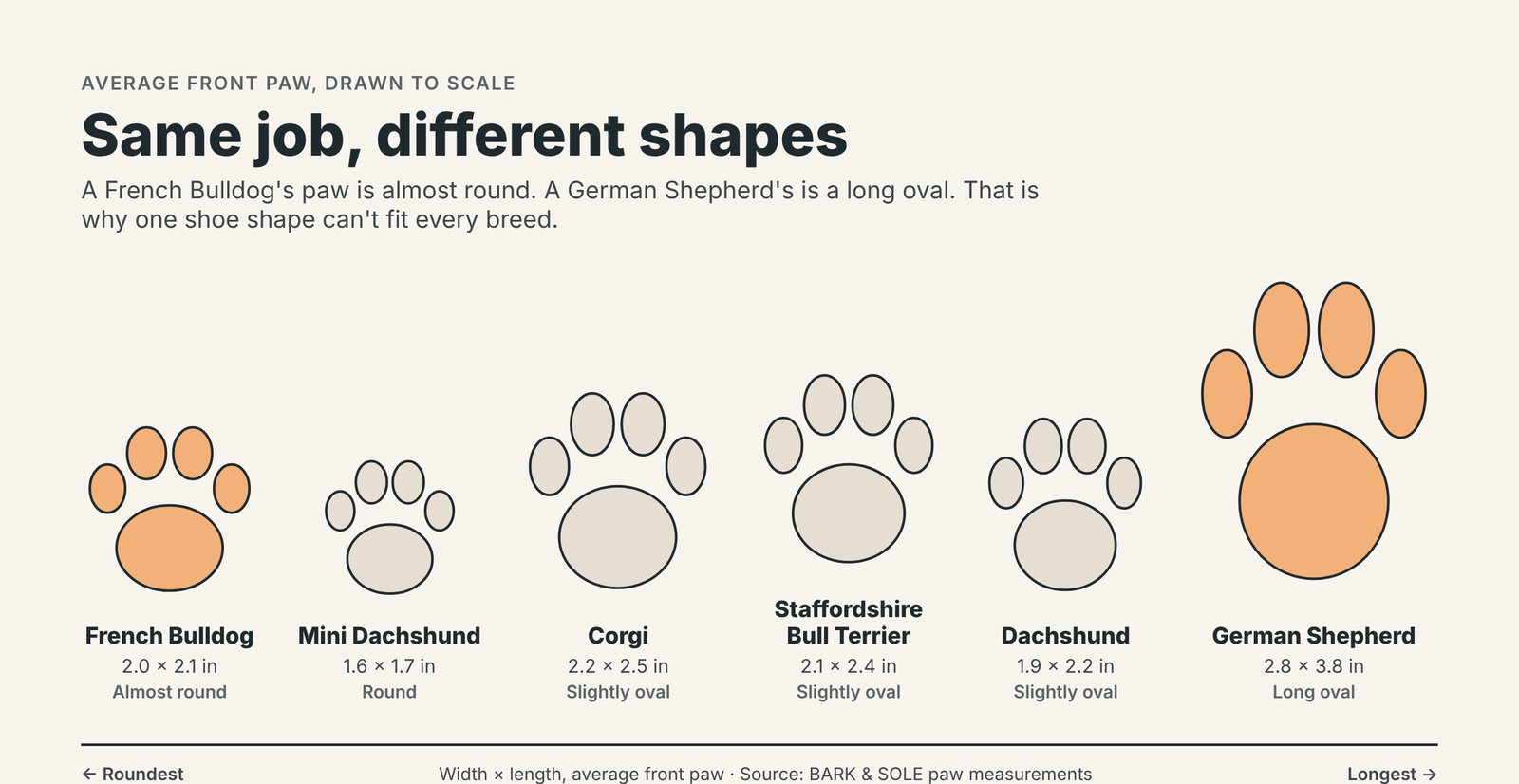
Most people think of dog paws as small, medium and large. In our measurements, the bigger difference is shape. The chart below shows the average front paw of six breeds we measure often, from the roundest paw to the longest.
| Breed | Paw shape | Front paw width | Front paw length |
|---|---|---|---|
| French Bulldog | Almost round | 2.0 in | 2.1 in |
| Miniature Dachshund | Round | 1.6 in | 1.7 in |
| Corgi | Slightly oval | 2.2 in | 2.5 in |
| Staffordshire Bull Terrier | Slightly oval | 2.1 in | 2.4 in |
| Dachshund | Slightly oval | 1.9 in | 2.2 in |
| German Shepherd | Long oval | 2.8 in | 3.8 in |
A French Bulldog's front paw is almost as wide as it is long: a compact, nearly round foot. A German Shepherd's paw is a long oval, only about three quarters as wide as it is long. If you took a shoe that fits a Frenchie and simply scaled it up to a German Shepherd's paw length, it would be nearly 30% too wide. Scale it to the width instead, and it would be far too short. This is why "size large" and "size small" rarely work for dogs with special needs.
The leg above the paw matters just as much. A shoe stays on because the ankle is narrower than the paw, giving the strap a ledge to sit behind. On a French Bulldog's back leg, the ankle is only about 0.6 in narrower than the paw. On a German Shepherd it is about 1 in. Add the Frenchie's short legs, and there is very little room to anchor anything. That small ledge is the main reason ordinary booties spin around or slide off short-legged breeds within a few steps.
Breed also shapes which conditions owners face. French Bulldogs and Dachshunds belong to the chondrodystrophic breeds, whose discs tend to degenerate early, which puts them at higher risk of IVDD. German Shepherds are one of the breeds best known for degenerative myelopathy. So the paws that most need protection often come with the shapes that are hardest to fit.
Front and Back Paws Are Not the Same Paw
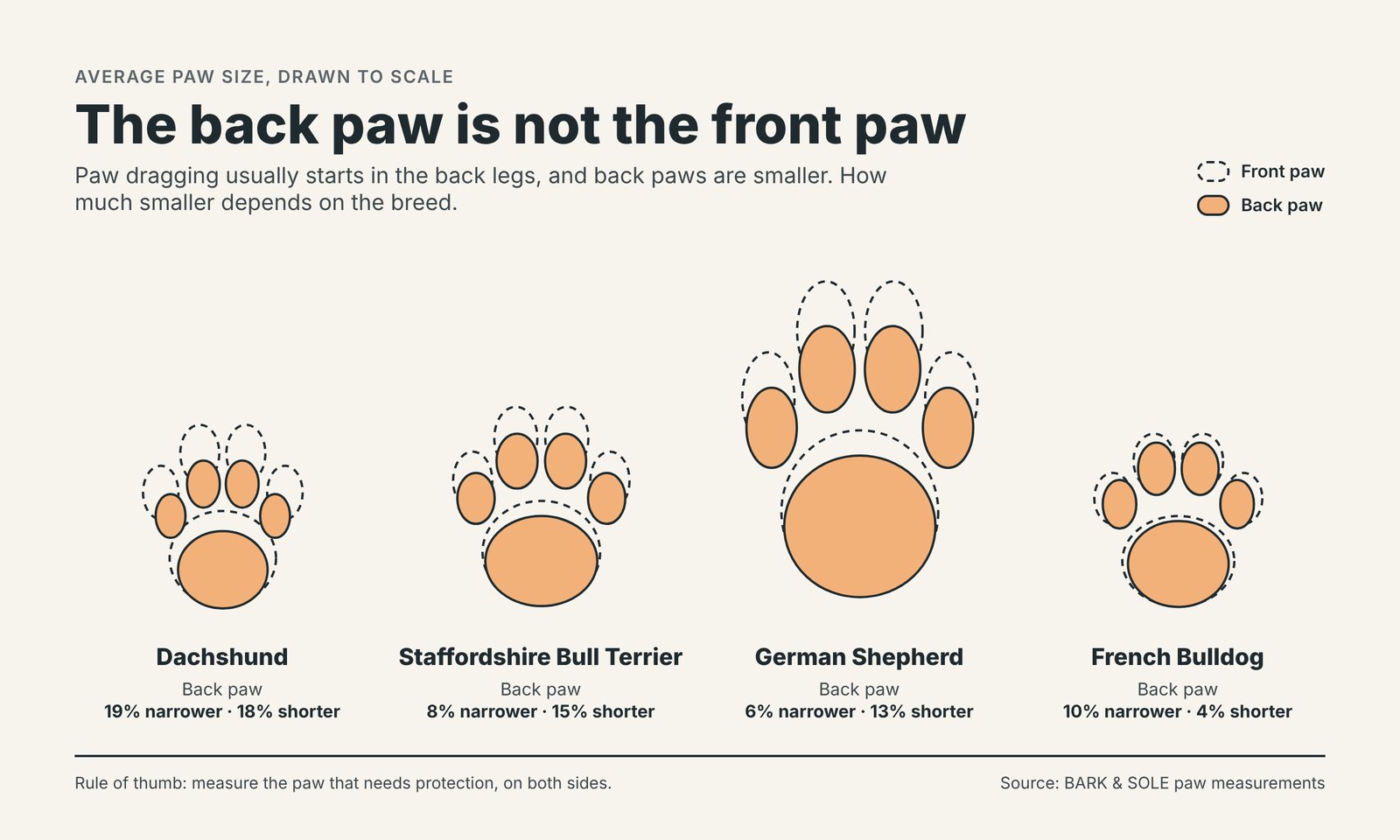
A dog carries roughly 60% of its weight on its front legs, and the front paws are built for it. In most breeds we measure, the back paws are noticeably smaller. How much smaller depends on the breed:
| Breed | Back paw narrower than front by | Back paw shorter than front by |
|---|---|---|
| Dachshund | 19% | 18% |
| Staffordshire Bull Terrier | 8% | 15% |
| German Shepherd | 6% | 13% |
| French Bulldog | 10% | 4% |
There are exceptions, too. In the Corgis and Miniature Dachshunds we have measured, the back paw is slightly longer than the front, even though it is narrower. No size chart catches that.
This matters because paw dragging almost always starts in the back legs. Most boots are sized from a front paw, or sold as a set of four identical shoes. On a Dachshund, a back shoe sized from the front paw would be almost a fifth too big in both directions. A loose shoe on a dragging paw twists, rubs and comes off, which is exactly what you are trying to prevent.
The practical rule: measure the paw that needs protection, not the one that is easiest to measure. Dragging paws can also change shape over time, as toes splay or the dog starts to bear weight differently. Measure both sides and check again every few months, because left and right paws are often not identical either.
Stella, Cacha and Webber: Same Problem, Different Paws
Recently, the team at Alpha Animal Rehab & Fitness trialled custom shoes with three of their patients: a German Shepherd and two French Bulldogs.
Stella is a German Shepherd with degenerative myelopathy. Cacha and Webber are French Bulldogs, both living with IVDD. Stella has long, oval paws on long legs. Cacha and Webber have round, compact paws on short legs, with that very small ankle ledge. Yet all three had the same everyday problem: they drag their back paws, and the paws were paying for it.

All three had tried ordinary dog boots before, and the result was the same. The boots slid around or fell off during walks, and the ones that stayed on did not protect the nails and the tops of the toes, which is exactly where a dragging paw takes the damage.
For the trial, each dog wore shoes made from their own back paw measurements, with a reinforced toe to take the scraping instead of the nails. Stella's shoe followed her long oval paw. Cacha's and Webber's were shorter and wider, shaped around round paws and short ankles. And even though Cacha and Webber are the same breed, their shoes were not identical: each was built from that dog's own measurements. Very different shoes, built to solve the same problem.

"Bark n Sole has made a remarkable difference in Cacha's mobility and overall paw health. Their durable, supportive booties have allowed his hind paws and nails to heal from repeated scuffing and dragging, while providing added stability and protection as he stands and walks. Whether navigating our rehabilitation facility or moving around at home, these booties have become an invaluable part of Cacha's rehabilitation journey."
The lesson for owners is not about one product. It is that protection only works when it fits the paw in front of you.
Home Care for Dragging Paws This Winter
New Jersey winters are hard on dragging paws. Cold pavement, ice, road salt and de-icers all add to the wear, and a small scrape can turn into a sore that lasts for weeks. A few simple habits make a real difference:
- Check the paws after every walk. Look at the nail tips, the tops of the toes and between the toes. Catching a red spot early is far easier than healing an open wound.
- Rinse off salt and de-icer. Wipe the paws with lukewarm water and dry them well, especially between the toes. Salt stings broken skin and dries out the pads.
- Keep walks short on rough or icy ground. Several short walks protect the paws better than one long one, and keep the muscles working. Choose snow or grass over salted sidewalks when you can.
- Add grip indoors. Dogs with weak hind legs often slip on hardwood, tile and laminate. Rugs and runners on your dog's usual routes help them get up and move with confidence.
- Introduce any footwear gradually. Start with short sessions and check the skin afterwards. Any rubbing or redness means the fit needs adjusting, not more wearing in.
- Measure the paw that drags. If you use shoes, measure the actual paw that needs protection, on both sides, and recheck every few months.
- Keep up the home exercises. Protection limits the damage, but strength and coordination are what keep your dog walking. Stick with the therapeutic exercise plan your rehab team gives you.
Socks and bandages can help indoors for short periods, but they wear through quickly on pavement and give little protection to the nails. For outdoor walks, a dragging paw needs something with a hard-wearing toe.
When to Seek Veterinary Rehabilitation
Paw protection treats the symptom on the ground. It does not treat the cause. If your dog has started dragging a paw, knuckling, stumbling or crossing their back legs, have them examined by your veterinarian. Sudden weakness, loss of balance or signs of pain need attention right away, as some spinal problems get worse quickly.
For dogs living with IVDD or DM, rehabilitation is where protection and progress meet. A rehab team can measure how your dog is moving, rebuild strength and coordination, and tell you which supports will help at each stage. At Alpha Animal Rehab & Fitness, that can include IVDD rehabilitation, the underwater treadmill, therapeutic exercise, and fitting for carts, harnesses and braces. Bring your dog's shoes or boots to the appointment too, so the team can see how they affect your dog's gait.
If your dog is dragging their paws, contact Alpha Animal Rehab & Fitness. The team can assess your dog and build a plan that keeps them walking, comfortably and safely, through the winter and beyond.
About the Author
Janne Loiske is the founder of BARK & SOLE, based in Turku, Finland. He started BARK & SOLE because of his own French Bulldog, Moe. Moe has a neurological condition that makes her drag her front paws. They tried every shoe on the market, but none worked for Moe: they all fell off. So they decided to make the shoes themselves.
Today BARK & SOLE makes shoes to each dog's own paw measurements, with a focus on dogs living with IVDD, degenerative myelopathy, arthritis and other mobility conditions. The shoes were developed together with orthopedic veterinarians. Owners can read more about the IVDD Warrior shoe that Stella, Cacha and Webber wore, the shoe for degenerative myelopathy, or the guide to measuring your dog's paws.
For Alpha Animal Rehab & Fitness clients: use the code ALPHA for 20% off your order at barkandsole.com, valid until November 30, 2026.
This article is intended for informational purposes only and should not be considered a substitute for professional veterinary advice. Always consult your veterinarian or a certified rehabilitation professional regarding your dog's individual needs and circumstances.